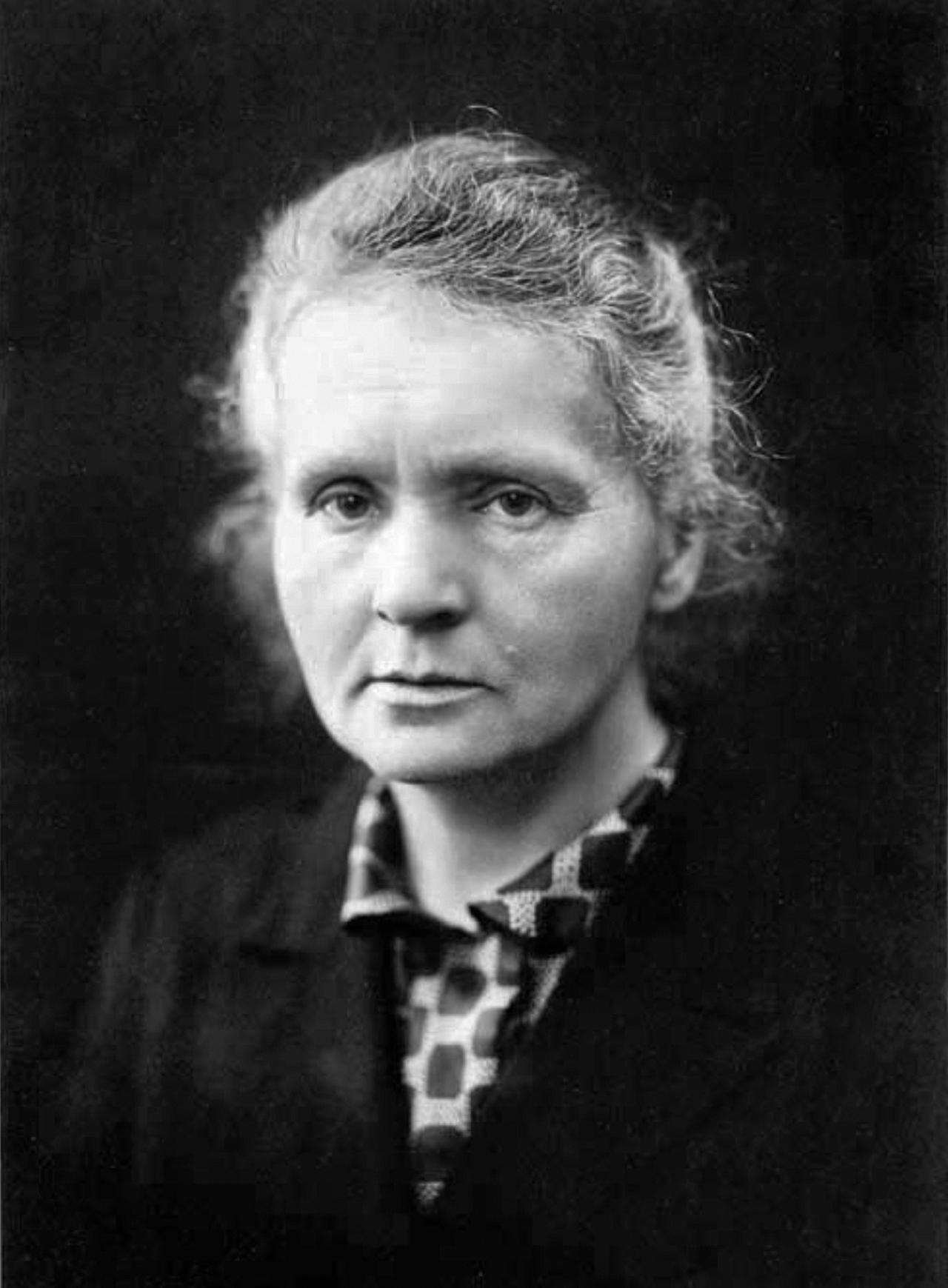
Marie Curie
Stand by the old well in the middle of Stortorget and face the long building on the north side of the square. Behind its doors is the Nobel Prize Museum, and in this tour this is where we imagine a statue of Marie Curie. There is no statue here today; it is an example placement, chosen because she belongs close to the museum's door.
Curie was the first person ever to be awarded two Nobel Prizes. The first, the Nobel Prize in Physics 1903, she shared with her husband Pierre Curie and with Henri Becquerel, for research on the radiation phenomena Becquerel had discovered. The second, the Nobel Prize in Chemistry 1911, was hers alone, for the discovery of the elements radium and polonium.
That second element is easy to read past. Polonium was named after the country of her birth. She was born Marie Skłodowska in Warsaw in 1867, when Warsaw belonged to the Russian Empire and Poland was not an independent state. Giving a new element the name of a country missing from the map was a deliberate choice.
More than a century later, she is still the only woman to have been awarded a Nobel Prize twice.
Any feedback for this story?